

Did you know that arbitrary dismissal without lawful grounds can result in penalties equaling three months' wages or more? Employers in the UAE often struggle with understanding their legal duties when terminating employment contracts, creating exposure to costly disputes and regulatory penalties. This guide clarifies the employer's role under Federal Decree-Law No. 33 of 2021, covering contract types, lawful termination grounds, notice periods, end-of-service benefits, and compliance strategies to protect your organization.
Table of Contents
- Introduction To Employer's Role In Contract Termination In UAE
- Types Of Employment Contracts And Their Impact On Termination Duties
- Lawful Grounds And Procedural Steps Employers Must Follow
- Employer Notice Periods, Communication, And Documentation Obligations
- Calculating And Paying End-Of-Service Benefits
- Legal Risks And Consequences Of Non-Compliance By Employers
- Common Misconceptions Employers Have About Contract Termination
- Practical Guidance For Employers And HR Professionals
- Explore MyWorkRights For Expert Employment Law Support
- What Are The Lawful Grounds For An Employer To Terminate A Contract In The UAE?
- Is A 30-Day Notice Period Always Required For Contract Termination By An Employer?
- How Should Employers Calculate And Pay End-Of-Service Benefits Under UAE Law?
Key takeaways
| Point | Details |
|---|---|
| Legal compliance is mandatory | Employers must follow Federal Decree-Law No. 33 of 2021 for all contract terminations to avoid penalties. |
| Contract type determines duties | Limited contracts expire automatically, while unlimited contracts require notice and lawful cause for termination. |
| Lawful grounds are required | Termination without documented cause risks financial compensation claims and reinstatement orders. |
| End-of-service benefits are non-negotiable | Gratuity must be calculated accurately and paid within 14 days of contract end. |
| Documentation protects employers | Proper records of termination grounds, notices, and payments defend against legal disputes. |
Introduction to employer's role in contract termination in UAE
Understanding your responsibilities as an employer in contract termination is not optional in the UAE. Federal Decree-Law No. 33 of 2021 establishes clear obligations that govern how you must end employment relationships, whether due to performance issues, redundancy, or contract expiry. Contract termination refers to the formal ending of the employment relationship initiated by the employer, requiring adherence to specific legal procedures to remain compliant.
Many UAE employers struggle with contract termination compliance leading to disputes, often because they underestimate the procedural rigor required. The legal importance of following prescribed termination processes cannot be overstated. Failing to document lawful grounds, provide proper notice, or calculate end-of-service benefits correctly exposes your organization to compensation claims and regulatory action.
Common pitfalls include:
- Assuming verbal agreements suffice for termination without written documentation
- Confusing the requirements for limited versus unlimited contracts
- Miscalculating gratuity or delaying final payments beyond legal deadlines
- Terminating employees without establishing and documenting lawful cause
These errors stem from incomplete knowledge of UAE labour law requirements. Proactive education and systematic compliance processes help you avoid these costly mistakes.
Types of employment contracts and their impact on termination duties
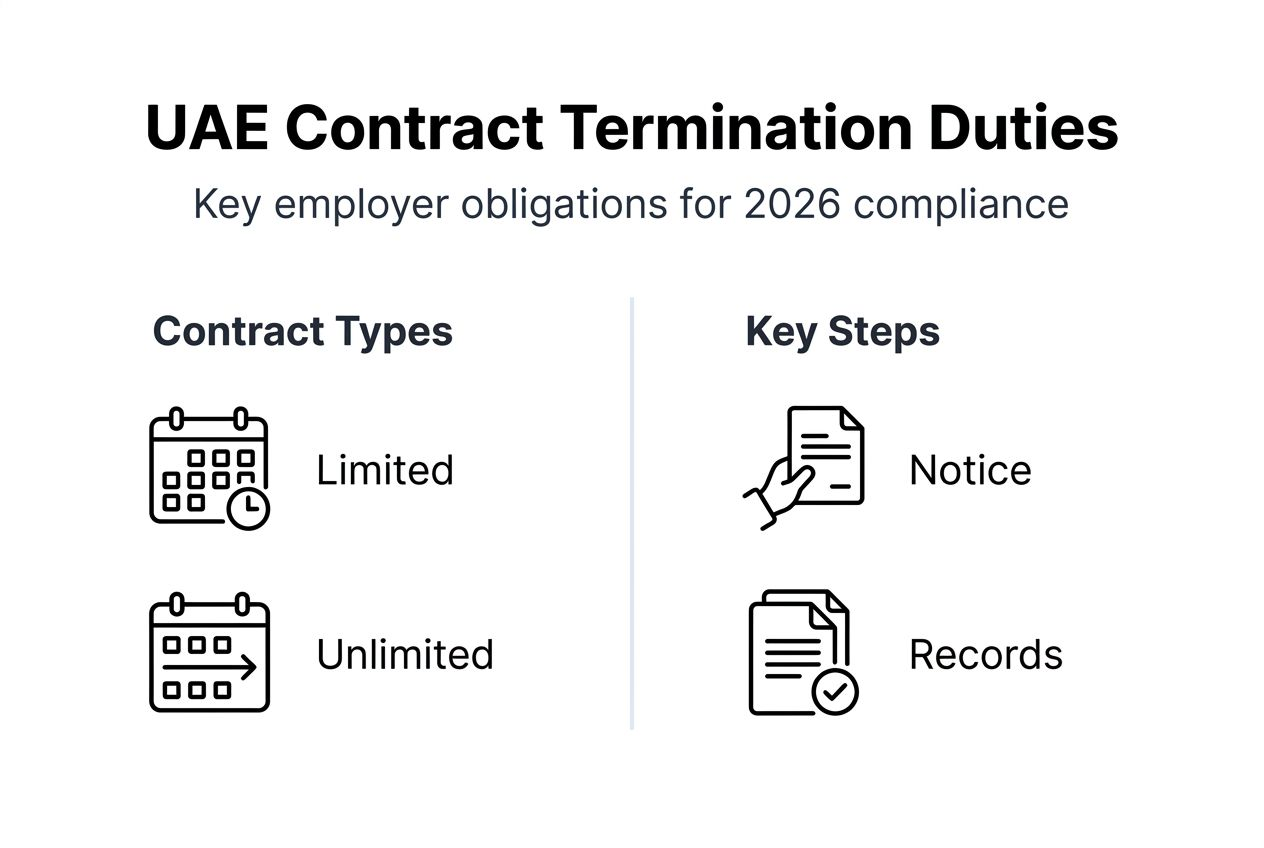
The UAE labor framework recognizes two primary contract types: limited and unlimited. Limited contracts specify a fixed end date and typically conclude automatically upon reaching that date without requiring advance notice from either party. Unlimited contracts have no predetermined expiry and continue until one party terminates the relationship following proper legal procedures.
This distinction dramatically shapes your termination obligations. Limited contracts expire automatically and have different termination requirements than unlimited contracts. If you need to end a limited contract before its expiry date, you must demonstrate lawful grounds and may face compensation claims for the remaining contract period. Unlimited contracts offer more flexibility but require you to provide notice and establish valid termination reasons.
| Contract Type | Notice Requirement | Termination Flexibility | Employer Risk |
|---|---|---|---|
| Limited | None at expiry; required if terminated early | Low flexibility before expiry | High compensation risk if terminated early |
| Unlimited | 30 days minimum | High flexibility with cause | Moderate risk if proper grounds documented |
Understanding employment contract types in UAE helps you plan workforce changes strategically. When hiring, consider which contract type aligns with your operational needs and provides appropriate termination flexibility.
Key differences include:
- Limited contracts automatically renew as unlimited if both parties continue the relationship beyond the expiry date without signing a new agreement
- Unlimited contracts provide ongoing employment security for workers but require employers to justify termination decisions
- Both contract types mandate payment of end-of-service benefits, though calculation methods differ based on service length
Lawful grounds and procedural steps employers must follow
You cannot terminate an employee arbitrarily in the UAE. The law defines specific lawful grounds permitting employer-initiated termination, including documented poor performance, serious misconduct, business closure, position redundancy, and employee failure to fulfill essential contract duties. Each ground requires supporting evidence that withstands potential legal scrutiny.

Arbitrary dismissal without lawful grounds or due process can lead to penalties including compensation awards and possible reinstatement orders. Documenting evidence becomes your primary defense. Performance-related terminations need written warnings, improvement plans, and evaluation records showing the employee failed to meet clearly communicated standards.
Follow these procedural steps to ensure compliance:
- Verify you have lawful grounds under Federal Decree-Law No. 33 of 2021 for the termination
- Gather and organize all supporting documentation including performance records, incident reports, or financial data justifying redundancy
- Prepare a written termination notice specifying the legal ground and effective date
- Deliver the notice according to contract terms and labor law requirements
- Calculate final payments including salary, unused leave, and end-of-service benefits
- Arrange the exit process including return of company property and final settlement
- Retain complete records of all termination documentation for potential legal review
Pro Tip: Create a dedicated termination file for each case containing chronological documentation from initial performance concerns through final settlement. This audit trail proves procedural compliance if the employee challenges the termination through Ministry of Human Resources channels or courts.
Maintaining clear records also helps you identify patterns in termination causes, enabling proactive management interventions that may reduce future separations.
Employer notice periods, communication, and documentation obligations
Notice period requirements form a cornerstone of compliant termination procedures. For unlimited contracts, you must provide a minimum 30-day notice before termination becomes effective. This notice period allows the employee time to seek alternative employment and ensures an orderly transition of responsibilities.
Exceptions to the 30-day rule exist in specific circumstances. Mutual written agreement between you and the employee can modify or waive the notice period. Cases involving gross misconduct such as theft, assault, or serious safety violations permit immediate termination without notice. Limited contracts reaching their natural expiry date do not require advance notice unless the contract explicitly states otherwise.
Communication protocols matter significantly. You must issue termination notices in writing, clearly stating the effective date and legal grounds. Verbal notifications lack enforceability and create disputes about timing and cause. Proper documentation of termination communications protects employers legally by establishing an official record of compliance.
Documentation retention best practices include:
- Keeping signed copies of all termination letters and acknowledgments
- Maintaining delivery receipts or email confirmations proving the employee received notice
- Filing payment records showing final settlement amounts and dates
- Preserving any employee responses or objections to the termination
Pro Tip: Develop standardized termination letter templates reviewed by legal counsel that include all mandatory elements. Templates ensure consistency across HR staff and reduce the risk of omitting critical information that could invalidate the notice.
These notice period obligations apply regardless of the employee's seniority or role. Even executive-level terminations require the same procedural compliance to remain legally defensible.
Calculating and paying end-of-service benefits
Gratuity represents a significant financial obligation you must fulfill upon contract termination. The calculation depends on the employee's length of service and basic salary. For employees who complete less than one year, no gratuity is owed. Those with one to five years of service receive 21 days of basic salary per year worked. Beyond five years, the rate increases to 30 days of basic salary per year.
Employers must calculate gratuity according to service duration and pay within legal deadlines to avoid penalties. Payment timelines are strict: you must settle all end-of-service benefits within 14 days of the contract termination date. Delays expose you to complaints and potential fines from labor authorities.
| Years of Service | Gratuity Calculation | Example (AED 10,000 monthly salary) |
|---|---|---|
| Less than 1 year | No gratuity | AED 0 |
| 1-5 years | 21 days × basic salary × years | AED 7,000 per year (total: AED 35,000 for 5 years) |
| Over 5 years | 30 days × basic salary × years beyond 5 | AED 10,000 per year beyond year 5 |
Documenting final settlement is not just good practice but legal proof of compliance. Prepare a detailed settlement statement showing salary owed, unused leave encashment, gratuity calculation breakdown, and any deductions. Both you and the employee should sign this document acknowledging the final payment.
Common employer errors in gratuity calculation include:
- Using gross salary instead of basic salary as the calculation base
- Failing to prorate gratuity for partial years of service
- Withholding gratuity improperly for employee misconduct without legal grounds
- Missing the 14-day payment deadline due to administrative delays
Refer to gratuity calculation guidelines for detailed examples covering various employment scenarios. Accurate calculations protect you from disputes and demonstrate your commitment to fair employment practices.
Legal risks and consequences of non-compliance by employers
The financial and reputational stakes of non-compliance are substantial. When you terminate employees without lawful grounds or proper procedures, you face potential penalties including compensation payments, reinstatement orders, and regulatory fines. Penalties for unlawful dismissal can include reinstatement, compensation up to three months' wages, or fines imposed by the Ministry of Human Resources and Emiratisation.
Common mistakes leading to litigation include:
- Terminating employees without establishing documented cause
- Failing to provide required notice periods for unlimited contracts
- Miscalculating or delaying end-of-service benefit payments
- Using discriminatory grounds for termination decisions
- Inadequate documentation of performance issues or misconduct
Beyond direct financial penalties, non-compliance damages your company's reputation in the labor market. Word spreads quickly through professional networks and online reviews when employers violate labor rights. This reputational harm makes recruiting quality talent harder and more expensive.
Arbitrary dismissal penalties can include compensation awards equal to three months' wages or more, representing a significant financial exposure for employers who fail to follow proper procedures and document lawful termination grounds.
Operational risks extend beyond individual cases. Patterns of non-compliance attract regulatory scrutiny that can trigger comprehensive audits of your HR practices. These audits disrupt operations and may uncover additional violations requiring costly remediation.
Protecting your organization requires systematic compliance processes, regular HR training on labor law updates, and consultation with employment law specialists in complex termination situations.
Common misconceptions employers have about contract termination
Many employers hold mistaken beliefs about termination laws that create compliance gaps. Clearing these misconceptions reduces your legal exposure and helps you make informed workforce decisions.
Myth: Providing notice alone permits termination without cause. This is false. Notice periods establish timing, but you still must demonstrate lawful grounds for unlimited contract terminations. Simply giving 30 days' notice without documented performance issues or legitimate business reasons leaves you vulnerable to arbitrary dismissal claims.
Myth: End-of-service gratuity is optional if the employee resigns. This is false. Gratuity entitlement depends on length of service and termination circumstances, not just who initiates the separation. Even when employees resign, they may be entitled to partial or full gratuity based on their service duration and resignation reasons.
Myth: Limited contracts require the same notice as unlimited contracts. This is false. Limited contracts typically conclude automatically at their expiry date without requiring advance notice. Early termination of limited contracts involves different procedures and potential compensation obligations compared to unlimited contract terminations.
Myth: Verbal warnings suffice for performance-based terminations. This is false. Labor law requires documented evidence of performance issues, warnings, and improvement opportunities. Verbal conversations alone cannot establish the paper trail needed to defend termination decisions legally.
Understanding these distinctions helps you implement termination procedures that withstand legal scrutiny and align with UAE labor law requirements.
Practical guidance for employers and HR professionals
Implementing compliant termination procedures requires systematic approaches. Use this checklist to guide each termination:
- Review the employment contract to confirm type (limited vs unlimited) and specific termination clauses
- Verify you have documented lawful grounds recognized under Federal Decree-Law No. 33 of 2021
- Prepare a written termination notice including effective date, grounds, and any notice period
- Calculate all final payments including prorated salary, unused leave, and gratuity
- Schedule a termination meeting to deliver the notice and explain next steps
- Arrange return of company property and deactivation of access credentials
- Process final payment within 14 days and obtain signed acknowledgment
- Retain complete termination documentation for minimum six years
Sample templates for written notices should include your company letterhead, employee name and position, termination effective date, specific legal grounds with supporting details, notice period if applicable, and instructions for final settlement. Having legal counsel review your templates before use ensures they meet all statutory requirements.
Consulting legal expertise becomes essential in complex cases involving senior executives, potential discrimination claims, or ambiguous performance situations. Employment law specialists help you assess risks and structure terminations defensively.
Pro Tip: Schedule regular training sessions for HR staff covering labor law updates and termination procedures. Quarterly refreshers keep your team current on regulatory changes and reinforce best practices, reducing costly mistakes from outdated knowledge or inconsistent application of policies.
Refer to notice period compliance tips for additional guidance on timing and communication requirements specific to different termination scenarios.
Explore MyWorkRights for expert employment law support
Managing contract terminations compliantly requires staying current with UAE labor law and implementing systematic HR processes. MyWorkRights offers comprehensive resources to support your compliance efforts. Access detailed articles on notice periods, gratuity calculations, and regulatory updates that keep you informed about your legal obligations.
Our platform provides practical tools including detailed articles on termination procedures and calculators that simplify complex benefit computations. Whether you need quick answers about specific termination scenarios or want to build comprehensive compliance programs, MyWorkRights delivers reliable guidance based on current UAE employment law. Visit today to strengthen your HR practices and protect your organization from avoidable legal disputes.
What are the lawful grounds for an employer to terminate a contract in the UAE?
Employers can terminate contracts based on documented poor performance, serious misconduct, business closure, position redundancy, or employee failure to fulfill essential contract duties. Each ground requires supporting evidence that demonstrates the termination was justified under Federal Decree-Law No. 33 of 2021. Arbitrary termination without documented cause exposes employers to compensation claims and potential reinstatement orders.
Is a 30-day notice period always required for contract termination by an employer?
The 30-day notice applies specifically to unlimited contracts under standard circumstances. Limited contracts reaching their natural expiry date do not require advance notice unless the contract specifies otherwise. Cases of gross misconduct permit immediate termination without notice, and mutual written agreement can modify notice requirements. Employers must follow documented procedures when adjusting standard notice periods to maintain legal compliance.
How should employers calculate and pay end-of-service benefits under UAE law?
Gratuity calculation depends on length of service and basic salary: 21 days per year for years one through five, and 30 days per year beyond five years. Payment must occur within 14 days of contract termination to meet legal deadlines. Employers should prepare detailed settlement statements showing the calculation breakdown and obtain signed acknowledgment from employees. Refer to gratuity calculation resources for detailed examples covering various employment scenarios and special circumstances.